
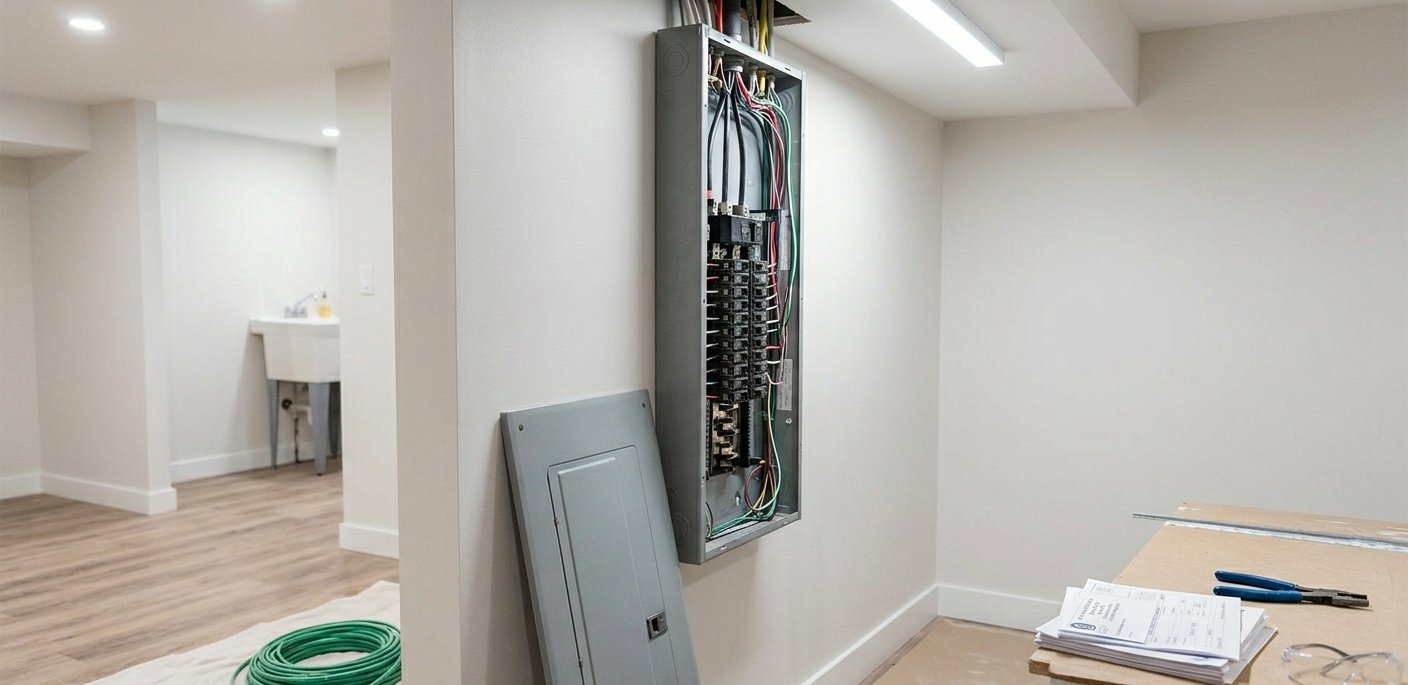
Adding a legal secondary suite is a top-tier investment for Ontario homeowners, but navigating the Ontario Electrical Safety Code (OESC) is critical to ensuring your project is safe and legal. One of the most common reasons for a failed Electrical Safety Authority (ESA) inspection is improper access to the electrical panel. If your tenant can’t reach their breakers, your suite isn’t just inconvenient—it’s non-compliant. Here is how to meet the ESA standards for your 2024 renovation.
The “Readily Accessible” Requirement
The ESA enforces Rule 6-206 1) b), which mandates that electrical service equipment must be “readily accessible.” In a multi-unit home, this means every occupant must be able to reach the overcurrent devices (breakers) protecting their own unit’s circuits without entering another private dwelling unit.
- Why it matters: In an emergency, a tenant needs immediate access to kill power. If your panel is locked behind your basement door or hidden in your master bedroom, you are in violation of ESA Bulletin 26-20-2.
Location Restrictions (Rule 26-600)
The OESC is very specific about where you cannot put a panel board. According to Rule 26-6001), panels must not be located in:
- Coal bins, clothes closets, or bathrooms.
- Stairways (you cannot mount a panel directly over stairs).
- High-ambient rooms (where temperatures exceed 30°C).
- Undesirable places (areas prone to moisture or mechanical damage).
Working Space & Mounting Heights
Even if the location is right, the “clearance” must be perfect. Per ESA Bulletin 2-9-9:
- The 1-Metre Rule: You must maintain at least 1 metre of unobstructed depth in front of the panel.
- Headroom: There must be at least 2 metres of headroom in the working space.
- Mounting Height: In a dwelling unit, Rule 26-600 2) requires the panel to be mounted as high as possible, but no breaker handle can be higher than 1.7 metres from the finished floor.
Best Design Solutions for Ontario Landlords
To ensure your renovation passes the ESA finish inspection, we recommend one of these three paths:
- Common Area Placement: Install the main panel in a shared laundry room or foyer that both the landlord and tenant can access 24/7.
- The Sub-Panel Approach: Keep the main service in the primary residence and install a separate sub-panel inside the secondary suite. This gives the tenant full control over their own circuits while keeping your power separate.
- Full Service Split: Upgrading to a 200-amp service with two separate meters. This is the preferred method for long-term rentals as it allows for independent billing.
Plan Your Legal Suite with the Experts
At Paul’s Contracting, we work exclusively with Licensed Electrical Contractors who handle all ESA notifications and permits on your behalf. Don’t risk your investment with an unlicensed “handyman” fix.
Want to see if your basement layout is ESA-compliant?
Book a Design Consultation
See our latest legal basement conversions
Comments are closed.